How Japanese Motorsport Works: From Karts to Formula 1
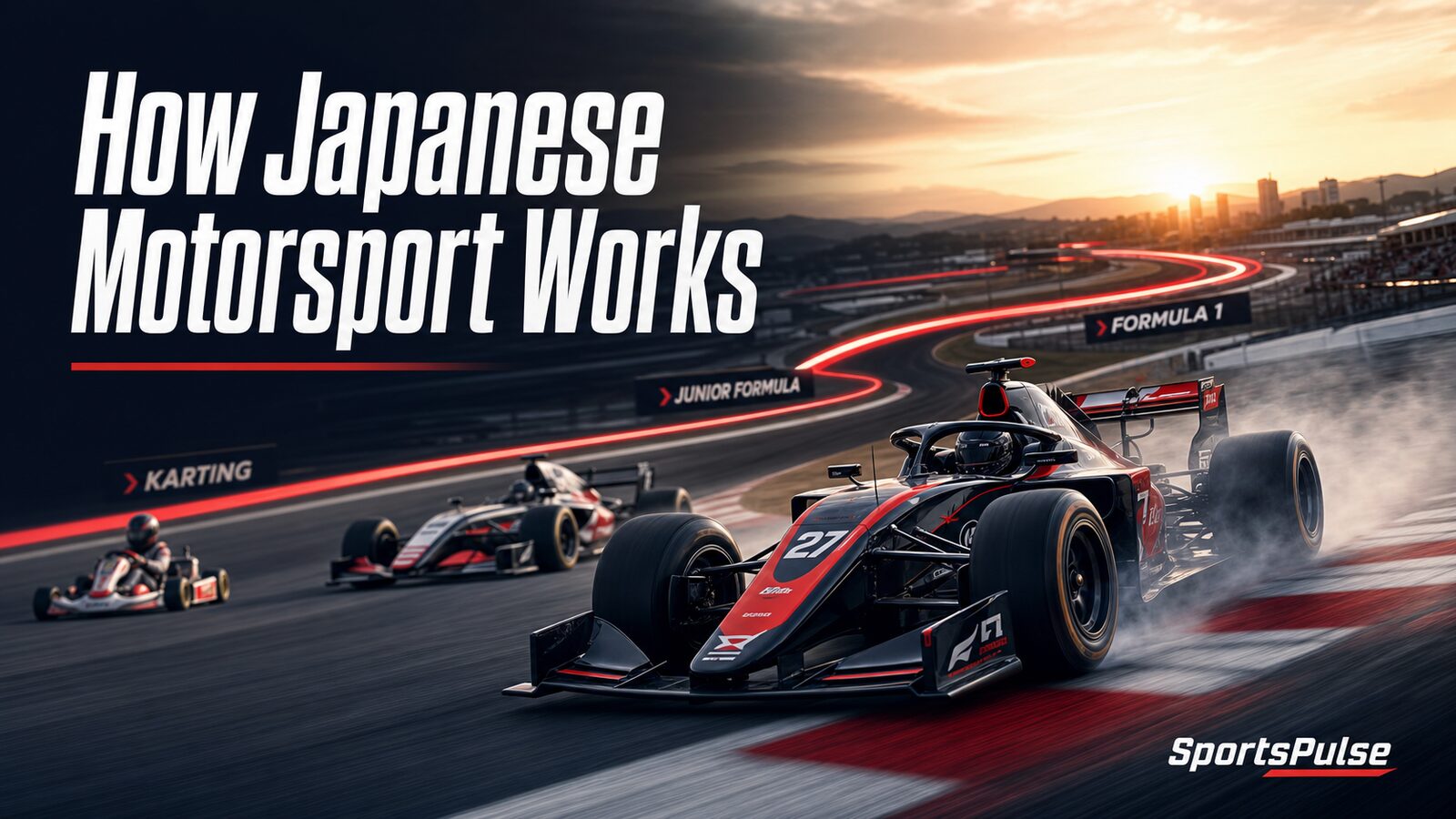
How Japanese Motorsport Works: From Karts to Formula 1
Japan has produced only six F1 drivers in history — but it runs one of the most complete domestic racing ladders in the world, with its own junior categories and two manufacturer academies fighting over the best teenagers. Here’s how a Japanese driver gets made.
Japan has a full domestic single-seater ladder: karting → Japanese F4 → an F3 tier (Formula Regional Japan and Super Formula Lights) → Super Formula → F2/F1. Two manufacturers run rival junior academies — Honda’s HFDP and Toyota’s TGR-DC — that fund the most promising drivers. The system has sent only six drivers to F1 ever (most recently Yuki Tsunoda), but the pipeline is busier than ever, with Honda’s continued F1 role keeping the door open.
In this guide
1. A complete domestic ladder
2. The academy war: Honda vs Toyota
3. Karts & racing schools
4. The output: six F1 drivers
5. Japan vs the European ladder
1. A complete domestic ladder
Most countries feed drivers straight into the European ladder. Japan built its own — all the way to a top class second only to F1.
A young Japanese driver can climb an entire single-seater pyramid without leaving the country, before the final jump to Europe:1
| Tier | Category | What it is |
|---|---|---|
| Entry | Karting | The grassroots start, from childhood |
| Step 1 | Japanese F4 | First single-seater (age 16+); a huge grid, with an amateur “Independent” class too |
| Step 2 | Formula Regional Japan / Super Formula Lights | The F3 tier — FRJ uses FIA Regional cars; Super Formula Lights feeds the top class |
| Peak | Super Formula | Japan’s top series — the fastest single-seaters after F1 |
| Beyond | F2 / F1 | The European step to a grand prix seat |
The two F3-level series sit side by side: Formula Regional Japanese Championship (built to FIA Formula Regional rules) and Super Formula Lights (the traditional F3-derived feeder that funnels directly into Super Formula).2 For the top of the pyramid, see our Super Formula explainer.
2. The academy war: Honda vs Toyota
What really powers the ladder is the rivalry between Japan’s two motorsport giants, each running a driver academy that spots, funds and develops teenagers:
Honda Formula Dream Project (HFDP) develops young drivers in Japanese F4, Super Formula Lights and junior categories in Europe, funding talent it hopes will one day race for Honda — its graduates include Yuki Tsunoda.3 Toyota Gazoo Racing Driver Challenge (TGR-DC) aims to build pros for race and rally worldwide; its TGR-DC Racing School runs young Toyota drivers in Japanese F4, and its alumni include Kamui Kobayashi and Le Mans winner Ryo Hirakawa.4
Because both makers also field works teams in Super Formula and Super GT, a Japanese driver can spend an entire career inside one manufacturer’s system — from a teenage F4 scholarship to a professional Super Formula seat.
3. Karts & racing schools
It starts, as everywhere, in karting — Japan has a deep grassroots kart scene that feeds the F4 grids. The manufacturers formalise the next step through racing schools: Honda’s Suzuka circuit school was rebranded the Honda Racing School Suzuka (HRS) in 2022, with top drivers and riders as instructors, while Toyota runs the TGR-DC Racing School.3 These schools double as scouting funnels — do well, and a manufacturer academy contract can follow.
4. The output: six F1 drivers
For all that structure, the headline number is small: in F1 history, only six Japanese drivers have raced in a grand prix.5
- Satoru Nakajima — the pioneer (1987–91), Japan’s first full-time F1 driver.
- Aguri Suzuki — a 1990 podium at Suzuka; later an F1 team owner.
- Takuma Sato — F1, then a two-time Indianapolis 500 winner.
- Kazuki Nakajima — F1, then three Le Mans wins with Toyota.
- Kamui Kobayashi — a fan favourite; now a Le Mans winner and team boss.
- Yuki Tsunoda — the most recent, an HFDP product who reached Red Bull’s F1 programme.
The current pipeline is deeper than the tally suggests: reigning Super Formula champion Ayumu Iwasa is a Red Bull reserve, and teenagers like Taito Kato are in FIA F3 with HFDP backing. ⚠ F1 seats and junior placements move every season. See Future Japanese F1 Drivers.6
5. Japan vs the European ladder
The European route is one straight line — FIA F4 → FIA F3 → F2 → F1. Japan runs a parallel ladder with its own F4, F3 tier and a uniquely strong top class in Super Formula. Drivers choose: chase Europe early (the only road to an F1 seat), or build a career at home, where Super Formula and Super GT offer well-paid professional racing.1
The Honda–Toyota rivalry runs through everything Japanese motorsport. We break down each maker’s story in this group — and you can see the rivalry on track in Super GT — and compare it with Super Formula. Japan’s motorsport industry runs deep, from Bridgestone’s F1 tyres to the Japanese Grand Prix.
In five lines
- Japan runs a full domestic ladder: karting → F4 → F3 tier → Super Formula → F2/F1.
- Two manufacturer academies — Honda HFDP and Toyota TGR-DC — fund the best teenagers.
- It starts in karting and the makers’ racing schools (HRS Suzuka, TGR-DC).
- Only six Japanese drivers have ever reached F1 — most recently Yuki Tsunoda.
- The pipeline is busy now; Honda’s F1 role keeps the door open. ⚠ Placements change yearly.
From a kart in Suzuka to the F1 grid
Meet the Japanese drivers climbing toward Formula 1 right now.
Sources & notes
- Japanese single-seater ladder (F4 / Formula Regional / Super Formula Lights / Super Formula). Super Formula Lights (Wikipedia) · Feeder Series
- Formula Regional Japanese Championship (FIA Regional) & Japanese F4. FRJ 2026 (Wikipedia) · F4 Japanese Championship
- Honda Formula Dream Project (HFDP) & Honda Racing School Suzuka. HFDP (Wikipedia) · Honda Racing
- Toyota Gazoo Racing Driver Challenge (TGR-DC). Toyota Gazoo Racing · TGR-DC (Wikipedia)
- Japanese drivers in F1 (six in history). List of Japanese F1 drivers (Wikipedia)
- Current pipeline (Iwasa, Kato). Motorsport.com · FIA F3
An explainer dated 18 June 2026 on public professional drivers and the structure of Japanese motorsport. Category names, formats and placements change each year — flagged ⚠ items should be confirmed against official sources.
🌐 More from Global · モータースポーツ
Japanese Cars At Le Mans / Rally Japan WRC / Super Formula Explained / Super GT Explained / Toyota Motorsport Story / WEC Hypercar Era / Best Seats At Suzuka / Future Japanese F1 Drivers / More in モータースポーツ
📅 更新履歴
| 日付 | 変更内容 |
|---|---|
| 2026年6月10日 | 初回公開 |
| 2026年7月25日 | 情報を更新 |
✅ ファクト再検証
最終検証日:2026年7月25日
SportsPulse 編集部が公開情報をもとに内容を確認しています。情報は確認時点のものです。最新情報は各公式サイトをご確認ください。